I'm a big gin fan and particularly love brands with a good story behind them, so I've always been intrigued by London distilled Sipsmith gin, especially as their gin is made not far from the part of West London I've lived around for the past five years, and they've also provided gin for previous pop ups I've done, including one I did based solely around their gins and vodkas. If you're a fan of Sipsmith gin, or want to learn more about it there's a couple of events I've checked out recently that you can go to to learn more.
The first is Sipsmith's Gin Palace Extravaganza, which I did with Georgie in June. We spent the evening with Sipsmith, first at their Chiswick distillery learning all things gin and brand, and then at the Princess Victoria (one of my favourite West London pubs) for a three course, Sipsmith inspired meal. At the distillery we were talked through the history of Sipsmith, who had a long battle to even begin making their sought after gin thanks to an ancient law brought in in 1751 that stipulated the legal minimum production of gin was 1800 litres in order to control the out of hand home brew production of the spirit that was then taking place in one out of four residential properties. This law never got changed until Sipsmith took on the government so they could start a 300 litre per year production. After two and a half years they finally got the law changed and were able to start their business making London dry gin (dry meaning that all botanicals have to be infused during the distillation process and not after). We sampled various gins at the distillery, including the original London Dry Gin, the VJOP (Very Junipery Overproof Gin - made with 75% more juniper and macerated for four times longer than the original gin, making it 57.4% abv and the perfect base for a Negroni), and the London Cup (a sippable punch infused with Earl Grey tea, borage, lemon verbena, Seville orange and other botanicals, and based on the cups/punches of old days).
We learnt about the actual production of Sipsmith gin. A base of British wheat spirit from East Anglia arrives at the distillery, weighing in at a whopping 96% abv. Water is added to reduce this down to 60% abv to enable the distillation process, then botanicals including Macedonian juniper berries, Bulgarian coriander seed, French angelica root, Spanish liquorice root, Italian orris root, Spanish ground almond, Chinese cassia bark, Madagascan cinnamon, Sevillian orange peel and Spanish lemon peel are all added. This mixture is heated, steeped and then macerated for 12 hours, leaving oily streaks from the botanicals across the liquid's surface. After maceration the liquid is heated to the boiling point of alcohol, which is 78.3 degrees celsius. The spirit turns to vapour which rises up the still. Sipsmith's stills have swan like necks, creating as much copper surface area as possible for the vapour to hit. The copper absorbs the impurities and sulphites, and the cleansed droplets then falls back down into the still. The vapour finally ends up in liquid form in the condenser which is surrounded by cold water pipes, and gin is formed. Very good gin!
With heads full of information and bellies only full of gin it was definitely time to head to the PV for food. As part of the Gin Palace Extravaganza (which costs £75 per person, and includes the tour, several drinks and a three course meal) Sipsmith arrange taxis from the distillery to the pub - which was a very welcome surprise on the very rainy night we were there!
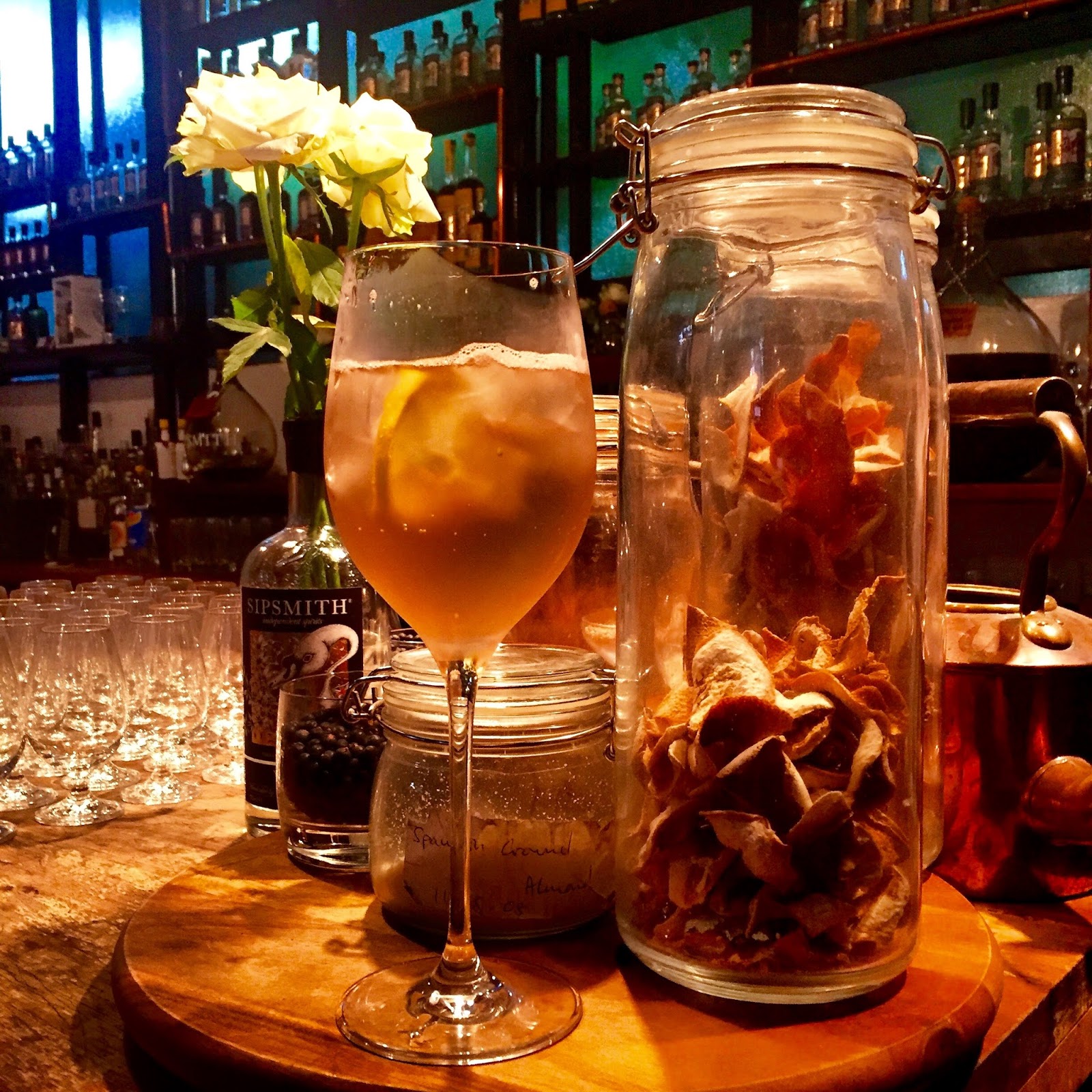
The first is Sipsmith's Gin Palace Extravaganza, which I did with Georgie in June. We spent the evening with Sipsmith, first at their Chiswick distillery learning all things gin and brand, and then at the Princess Victoria (one of my favourite West London pubs) for a three course, Sipsmith inspired meal. At the distillery we were talked through the history of Sipsmith, who had a long battle to even begin making their sought after gin thanks to an ancient law brought in in 1751 that stipulated the legal minimum production of gin was 1800 litres in order to control the out of hand home brew production of the spirit that was then taking place in one out of four residential properties. This law never got changed until Sipsmith took on the government so they could start a 300 litre per year production. After two and a half years they finally got the law changed and were able to start their business making London dry gin (dry meaning that all botanicals have to be infused during the distillation process and not after). We sampled various gins at the distillery, including the original London Dry Gin, the VJOP (Very Junipery Overproof Gin - made with 75% more juniper and macerated for four times longer than the original gin, making it 57.4% abv and the perfect base for a Negroni), and the London Cup (a sippable punch infused with Earl Grey tea, borage, lemon verbena, Seville orange and other botanicals, and based on the cups/punches of old days).
We learnt about the actual production of Sipsmith gin. A base of British wheat spirit from East Anglia arrives at the distillery, weighing in at a whopping 96% abv. Water is added to reduce this down to 60% abv to enable the distillation process, then botanicals including Macedonian juniper berries, Bulgarian coriander seed, French angelica root, Spanish liquorice root, Italian orris root, Spanish ground almond, Chinese cassia bark, Madagascan cinnamon, Sevillian orange peel and Spanish lemon peel are all added. This mixture is heated, steeped and then macerated for 12 hours, leaving oily streaks from the botanicals across the liquid's surface. After maceration the liquid is heated to the boiling point of alcohol, which is 78.3 degrees celsius. The spirit turns to vapour which rises up the still. Sipsmith's stills have swan like necks, creating as much copper surface area as possible for the vapour to hit. The copper absorbs the impurities and sulphites, and the cleansed droplets then falls back down into the still. The vapour finally ends up in liquid form in the condenser which is surrounded by cold water pipes, and gin is formed. Very good gin!
With heads full of information and bellies only full of gin it was definitely time to head to the PV for food. As part of the Gin Palace Extravaganza (which costs £75 per person, and includes the tour, several drinks and a three course meal) Sipsmith arrange taxis from the distillery to the pub - which was a very welcome surprise on the very rainy night we were there!


